YAG Capsulotomy
Months or years after cataract surgery, vision can turn hazy again. The cataract has not come back. The thin capsule that holds the lens implant has turned cloudy behind it, which is often called a "secondary cataract". A YAG laser capsulotomy makes a clear opening in the center of that capsule. It takes a few minutes in the office, has no cuts or stitches, and usually brings vision back to where it was after the cataract surgery.
Press Fire laser to see what happens, in the eye and in what you see.
The animation needs JavaScript. The picture and the explanation below cover the same thing.
Why the capsule turns cloudy
The eye's natural lens sits inside a clear, thin bag called the capsule. In cataract surgery the cloudy lens is removed from the bag and the implant is placed inside it, so the capsule keeps the implant centered for life.
A few lens cells always stay behind on the capsule. In some eyes they slowly spread across the back of it and turn it hazy or wrinkled. This is called posterior capsule opacification. It is the most common reason for vision to blur after successful cataract surgery, and it is not a complication or a sign that anything was done wrong. It can show up within months or after many years, and it is more common in younger patients.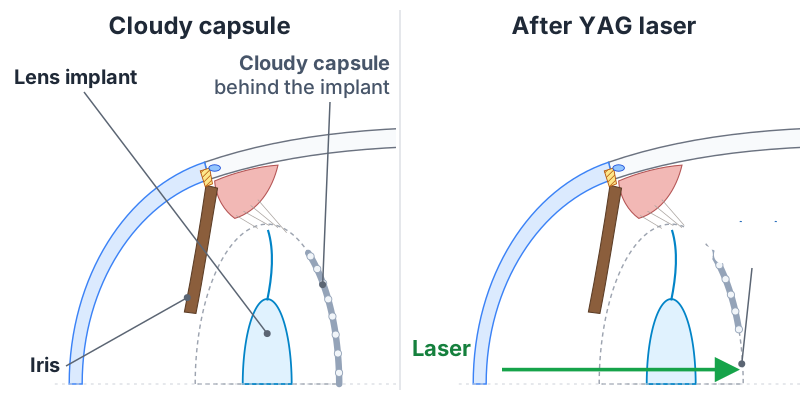
What it feels like
- Vision that has become hazy, filmy or dim again, like looking through a dirty window
- Glare and halos, especially from headlights at night
- Trouble reading even with the right glasses
- The feeling that the cataract is coming back
The change is gradual. Your doctor can see the cloudy capsule at the slit lamp once the pupil is dilated.
How the laser helps
The YAG laser focuses a very short pulse of energy on the capsule, just behind the implant. Each pulse makes a tiny opening, and a few of them together clear a window in the center about as wide as the pupil. Light then passes straight through to the retina. The implant is not moved or changed.
The capsule cannot grow back across the opening, so the laser is usually needed only once in each eye.
When to have it done
When the haze bothers you: when it gets in the way of driving, reading or the things you enjoy. There is no harm in waiting, and no need to treat a cloudy capsule that is not affecting you. Your doctor may also suggest it if the haze blocks the view needed to check your retina or optic nerve.
The visit
- Drops are placed in the eye to dilate the pupil. Some doctors add a drop to prevent a pressure rise.
- You sit at the laser, which looks like the slit lamp used for your exams, with your chin and forehead on the rests.
- The doctor applies the laser. You will see flashes and hear a soft click with each pulse. It does not hurt, and it is over in a minute or two. Usually nothing touches the eye; some doctors use a contact lens to focus the laser, with a numbing drop first.
- You can go home right away. A pressure check afterward is not usually needed; your doctor may do one if you have glaucoma or are at higher risk.
If both eyes need it, they can often be treated at the same visit, because the laser is so safe. Some doctors prefer separate visits. Bring a driver: the dilating drops blur your vision for several hours.
After the laser
- Vision is blurry for a few hours from the dilating drops, then clears. Most people notice the improvement by the next day.
- New floaters are expected. They are small pieces of the capsule drifting in the gel of the eye, and they settle and fade over a few weeks.
- You may be given an anti-inflammatory drop for a few days, or none at all, depending on your doctor's preference.
- Keep using any glaucoma drops as usual.
- There are no activity restrictions.
Call the same day if you have flashes of light, a sudden shower of new floaters, a curtain or shadow in your side vision, eye pain, or vision that gets worse instead of better.
Risks
YAG capsulotomy is one of the safest procedures in eye care. Problems are uncommon.
- A temporary rise in eye pressure in the first hours. It is uncommon and usually settles on its own. It matters most if you have glaucoma, in which case your doctor may use a preventive drop or check your pressure.
- Floaters that stay noticeable beyond the first few weeks, in a small number of people.
- Retinal detachment is rare, but the risk is slightly higher after the laser, more so in very nearsighted eyes. The warning signs are the ones listed above.
- Swelling of the central retina (macular edema) is rare and is treated with drops.
- A small mark on the implant from the laser can happen and almost never affects vision. Movement of the implant is very rare.
If you have glaucoma
The laser is safe with glaucoma, including after a trabeculectomy, tube shunt or MIGS. Your doctor may add a pressure-lowering drop for the day or check your pressure afterward. A clear capsule also gives a better view of the optic nerve and sharper scans and visual field tests.
Questions worth asking
- Is the cloudy capsule the reason my vision has changed, or is something else going on?
- How much improvement should I expect?
- Do I need any drops afterward?
- Is my risk of a retinal detachment higher than usual?
- When will my glasses prescription be checked again?