Preparing for Cataract Surgery
Published
This page walks through cataract surgery in order: the weeks before, the day itself, and the first month. Every surgeon and surgery center has its own instructions, and theirs come first. What is here is the usual pattern, so you know what to expect and what to ask. The operation itself is described on Cataract Surgery.
In the weeks before
The measurements. A visit is set aside to measure the eye for the lens implant: mainly the length of the eye and the curve of the cornea. The tests are painless; you look at a light while a machine scans the eye.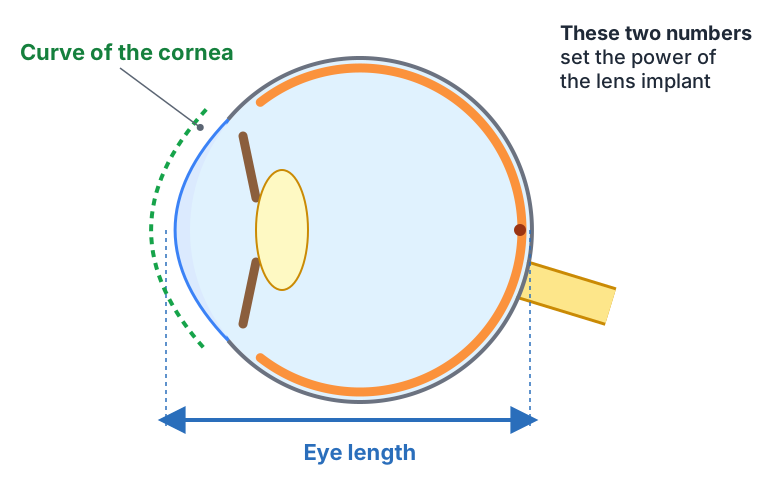
- Contact lenses change the shape of the cornea. You may be asked to leave them out for several days to a few weeks before the measurements, longer for rigid lenses.
- Dry eye can throw the measurements off, so it is sometimes treated first and the eye measured again.
Choosing the lens. The kind of implant decides what you will see without glasses afterward. See Choosing a Lens Implant and think about what matters most to you: driving, reading, the computer, night vision, cost.
Your medicines and health. Tell the surgical team about:
- Tamsulosin (Flomax) or similar prostate or bladder medicines, now or in the past. They affect how the iris behaves during surgery, and the surgeon plans for it.
- Blood thinners. Most are continued for cataract surgery, but confirm with your surgeon rather than stopping on your own.
- Diabetes, and how your blood sugar is managed, since you may be asked not to eat beforehand.
- Allergies, and any trouble lying flat or keeping still, such as back pain, breathing problems or anxiety.
Some centers ask for a check-up with your own doctor before surgery. If you have glaucoma, ask whether a glaucoma procedure (MIGS) should be done at the same time.
The days before
- Drops. Some surgeons start an antibiotic or anti-inflammatory drop a day or more before surgery. Fill the prescriptions early, so you have every drop at home before the day.
- A driver. You cannot drive yourself home. Arrange someone to take you and, ideally, to stay for the rest of the day.
- Plan for the first week: light activity, no heavy lifting, and someone to help if you live alone or care for others.
- No eye makeup for a day or two before, and none on the day.
The day of surgery
- Eating and drinking. Follow the center's instructions exactly, usually nothing by mouth for several hours before.
- Your usual medicines, including glaucoma drops, are usually taken as normal unless you were told otherwise.
- Wear comfortable clothes, leave jewelry at home, and bring a list of your medicines and your drops.
- Expect to be there two to three hours. The eye is numbed, you are given light sedation, and the operation itself takes about 10 to 20 minutes. You are awake but relaxed, and see lights and colors rather than the surgery.
- You go home with a shield over the eye. Rest for the rest of the day. Vision is often blurry at first; that is normal.
The first week
- A check the next day, or within a few days, to see the eye and measure the pressure.
- Drops on a schedule. A typical plan is an antibiotic for a week and a steroid and an anti-inflammatory tapered over about four weeks, but surgeons vary. The Post-Op Eye Drop Schedule tool lays out a day-by-day chart. Keep using any glaucoma drops in both eyes unless you are told otherwise.
- The shield at night for about a week, so you do not rub the eye in your sleep.
- No rubbing or pressing on the eye. Avoid heavy lifting and bending with your head down for the first week, and swimming and hot tubs for two weeks.
- Showering is fine; keep soap and water out of the eye.
- Reading, screens, walking and television are fine from the first day.
- Driving is usually possible within a few days, once your vision meets the legal standard and your surgeon agrees.
Common and expected: a scratchy feeling, mild ache, light sensitivity, a red patch on the white of the eye, colors looking brighter or bluer, and an arc of light at the edge of vision for a few weeks.
Weeks two to four
- Vision keeps sharpening as the eye settles.
- Finish the drops as scheduled, tapering as instructed.
- Glasses are usually checked about four weeks after surgery. Until then, an old pair or inexpensive reading glasses can fill in.
- The second eye, if it needs surgery, is often done one to several weeks after the first. The time between can feel unbalanced, especially if one eye needed strong glasses; it settles once both are done.
Call the same day if
- Vision gets worse after it had started to improve
- Pain is increasing or severe
- Redness increases, or there is discharge
- You see many new floaters, flashes of light, or a curtain over part of your vision
See When to Call the Same Day for other urgent symptoms.
Later on
Months or years later, vision can turn hazy again because the capsule behind the implant has clouded. This is common and is cleared with a quick office laser, a YAG capsulotomy.
Questions worth asking
- How long should my contact lenses stay out before the measurements?
- Which of my medicines should I take on the day, and which should I hold?
- Which drops do I start, and when?
- When can I drive, work and exercise again?
- When will my second eye be done?