Other Types of Glaucoma
Published
The most common kind of glaucoma is primary open-angle glaucoma, described on What Is Glaucoma?. Angle closure has its own page, Narrow Angles and Angle Closure. The types below are less common, but each has features that change how it is followed and treated. In every one, the damage is to the optic nerve, and the treatment that protects it is lowering eye pressure.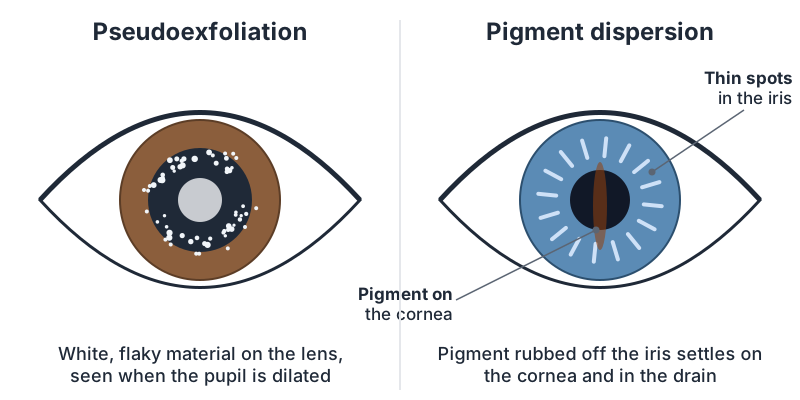
Normal-tension glaucoma
The optic nerve is damaged even though the eye pressure has always measured in the normal range. The nerve appears to be more fragile, and blood flow to it may play a part.
- More common in people of Japanese and East Asian ancestry, and in women.
- Associated with low blood pressure (especially at night), migraine, cold hands and feet, and sleep apnea.
- Treatment still lowers the pressure, by around a third from where it started. A large study (the Collaborative Normal-Tension Glaucoma Study) found this slowed the damage in many patients, though not all progressed without it.
- Tell your other doctors. Blood pressure medicines taken at bedtime can lower blood pressure further at night; it is worth discussing the timing with whoever prescribes them. Diagnosed sleep apnea should be treated.
- Before the diagnosis is made, other causes of optic nerve damage are sometimes ruled out, occasionally with a brain scan.
Pigment dispersion and pigmentary glaucoma
In some eyes the iris bows slightly backward and rubs against the fibers that hold the lens. Pigment flakes off the back of the iris, floats in the fluid and settles in the drain, which can clog it.
- Typical in young adults, more often men, who are nearsighted.
- Signs: spoke-like thin spots in the iris, pigment on the back of the cornea and in the drain.
- Exercise that jolts the body, such as running, can release a burst of pigment, with brief blurring or halos and a rise in pressure.
- Treatment: drops, and SLT laser, which works well in these heavily pigmented drains though usually at a lower energy. The pigment release often quiets down with age, and pressure can improve.
- Not everyone with pigment dispersion develops glaucoma; regular checks tell which course an eye is taking.
Pseudoexfoliation glaucoma
A white, flaky protein material is made in the eye and collects on the lens and in the drain. It is the most common identifiable cause of open-angle glaucoma worldwide.
- More common with age and in people of Scandinavian ancestry, though it occurs everywhere. It often starts in one eye.
- Pressure tends to be higher and to swing more, and the glaucoma can progress faster, so follow-up is closer.
- Treatment: drops, SLT laser, which often works well, and surgery when needed.
- Cataract surgery is more delicate, because the material weakens the fibers holding the lens and the pupil may not dilate well. Your surgeon plans for it; tell any eye surgeon you have it.
Secondary glaucomas
Glaucoma can also be caused by something else in or around the eye:
- Steroid-induced glaucoma. Steroids in any form, including eye drops, pills, inhalers, nasal sprays, skin creams and injections near the eye, can raise eye pressure in some people. The rise usually reverses when the steroid is stopped or changed, but not always. If you need steroids long term, your eye pressure should be checked.
- Inflammation (uveitis). Inflammation inside the eye can clog or scar the drain, and its treatment, steroids, can raise the pressure too.
- Neovascular glaucoma. In advanced diabetic eye disease or after a blocked retinal vein, abnormal vessels grow over the drain and close it. It is treated with injections and laser to the retina to shrink the vessels, and often with a tube shunt or cyclophotocoagulation.
- After an injury. A hard blow to the eye can tear the drainage angle (angle recession). Glaucoma can follow months or many years later, so an eye that was badly hit should be checked for life.
- After eye surgery, such as retinal surgery or a corneal transplant, pressure can rise and needs watching.
Glaucoma in babies and children
Glaucoma is rare in children. In infants, the drain may not have formed properly (congenital glaucoma). Signs include:
- Large or cloudy-looking eyes
- Tearing and strong sensitivity to light, with the child keeping the eyes shut
These need prompt care from a pediatric eye doctor. Childhood glaucoma is usually treated with surgery to open the drain, and children need lifelong follow-up.
Questions worth asking
- Which type of glaucoma do I have, and does it change my treatment?
- Is my type more likely to progress, and how often should I be seen?
- Should my other doctors change any of my medicines?
- Should my family members be checked?