MIGS
Minimally invasive glaucoma surgery (MIGS) is a family of procedures that lower eye pressure through very small openings, with less disruption to the eye and a faster recovery than traditional glaucoma surgery. Most are performed at the time of cataract surgery through the same incision, adding a few minutes to the operation. Some can be done on their own.
MIGS is generally for mild to moderate open-angle glaucoma, with the goal of lowering pressure modestly and reducing the number of drops needed. It is not usually a replacement for trabeculectomy or a tube shunt in advanced disease, where larger pressure reductions are needed.
The main approaches
Most MIGS procedures work by improving the eye's natural drainage through the trabecular meshwork and the channel behind it (Schlemm's canal).
- Trabecular micro-stents (iStent, Hydrus). Tiny implants, smaller than a grain of rice, placed in the drainage meshwork to hold a path open from the front of the eye into Schlemm's canal. They stay in permanently and are not visible or felt.
- Canal procedures (OMNI, goniotomy with the Kahook Dual Blade, gonioscopy-assisted transluminal trabeculotomy). Rather than implanting a device, the surgeon opens or dilates the meshwork and canal directly. OMNI combines dilating the canal with cutting a strip of meshwork and can be done with cataract surgery or alone ("standalone Omni").
- Subconjunctival micro-shunts (XEN gel stent). A soft tube drains fluid under the conjunctiva, the thin skin over the white of the eye, forming a small reservoir ("bleb") similar to a trabeculectomy but with a smaller operation. This is used for somewhat more advanced disease.
- Cyclophotocoagulation (micropulse or standard CPC) is a laser applied to the outside of the eye to reduce fluid production. It is not an angle procedure but is often grouped with less invasive options, and is used when other surgery is not suitable or has not worked.
Which procedure fits you depends on the type and severity of glaucoma, the anatomy of your drainage angle, whether you are having cataract surgery, and your target pressure.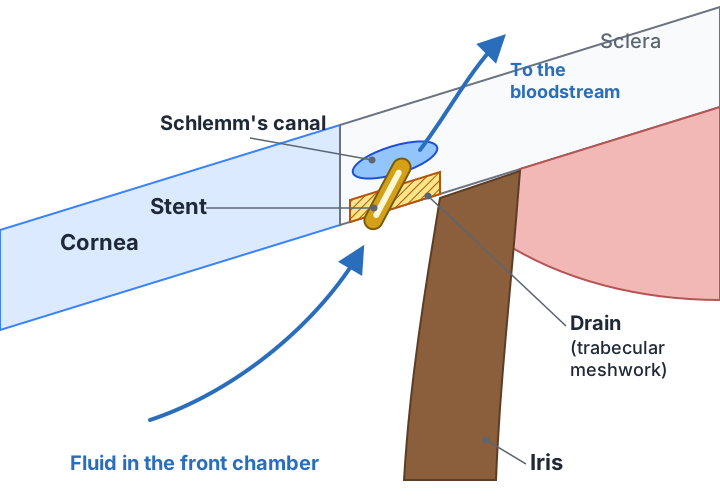
What to expect
Before. The workup is the same as for cataract surgery, plus gonioscopy to confirm the angle is suitable. Blood thinners usually do not need to be stopped, but tell your surgeon everything you take.
The day of surgery. It is done at an outpatient surgery center with numbing drops or a local block and light sedation. Combined with cataract surgery, the whole procedure typically takes 15 to 30 minutes. You go home the same day with a shield over the eye and need a driver.
After. Vision is blurry for a day or two and improves over the first week. You will use an antibiotic drop for about a week and a steroid drop tapered over about a month; the Post-Op Eye Drop Schedule tool lays this out day by day. Your usual glaucoma drops may be continued, reduced or stopped depending on your pressure at follow-up, which is checked at about one day, one week and one month. Avoid rubbing the eye, swimming and heavy lifting for the first couple of weeks.
A small amount of blood inside the eye (hyphema) is common with angle procedures and clears within days. It can make the first few days blurrier than after cataract surgery alone.
Results
On average MIGS lowers pressure by a few millimeters and reduces drop use by one to two medications, with many patients off drops entirely. The effect is more modest than trabeculectomy or a tube but with far fewer complications. Pressure is monitored lifelong, and if it rises later, drops, laser or further surgery remain possible; MIGS does not close off those options.
Risks
Complications are uncommon and usually minor: temporary bleeding inside the eye, a brief pressure spike, inflammation, or a device that sits slightly out of position. Serious complications such as infection or a large pressure drop are rare, much less common than with traditional glaucoma surgery. The main limitation is that the pressure lowering may not be enough, in which case additional treatment is needed.
Questions worth asking
- Which MIGS procedure do you recommend for my eye, and why that one?
- How much pressure lowering should I expect, and how many drops might I stop?
- Will this be combined with cataract surgery?
- If it is not enough, what would the next step be?