Macular Degeneration
Age-related macular degeneration (AMD) is wear of the macula, the small central part of the retina used for reading, recognizing faces and seeing fine detail. It is the most common cause of central vision loss after 60. It does not affect side vision, so it does not cause total blindness, and it is painless. There are two forms, dry and wet, and they behave very differently.
Choose a form and press Play.
The animation needs JavaScript. The pictures and the explanation below cover the same thing.
Dry and wet
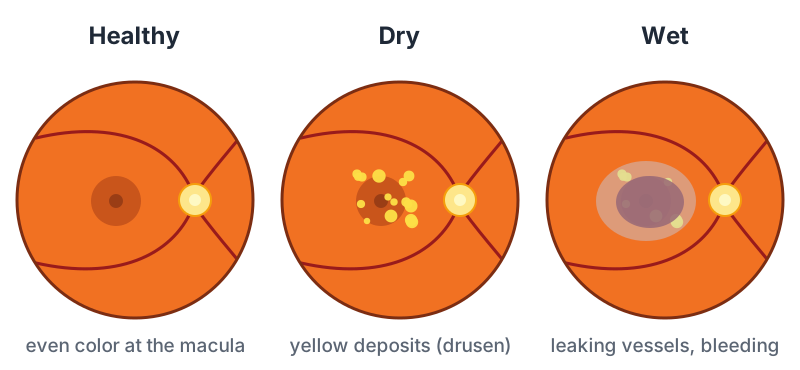
- Dry AMD is by far the more common form, about nine cases in ten. Yellow deposits called drusen collect under the macula, and over years the light-sensing cells can thin. It moves slowly. Many people with early dry AMD never lose useful vision.
- Wet AMD develops in a minority of people who have the dry form. Abnormal blood vessels grow under the macula and leak fluid or bleed. Vision can change over days to weeks. It is treatable, and the results are best when treatment starts quickly.
What it does to vision
- Blurred or dim central vision; needing more light to read
- Trouble recognizing faces
- Straight lines that look wavy or bent, which suggests the wet form
- A grey, dark or blank spot near the center
To see this on an everyday scene, try "Macular degeneration" in the vision loss simulator.
Checking at home: the Amsler grid
Dry AMD can turn wet without warning, and the first sign is usually distortion. A grid of straight lines makes distortion easy to notice. Check each eye, one at a time, once or twice a week:
- Wear your reading glasses and hold the grid at reading distance in good light.
- Cover one eye.
- Look at the center dot and keep looking at it.
- While looking at the dot, notice whether all the lines are straight and all the squares are there.
- Repeat with the other eye.
The grid needs JavaScript. The picture below shows it.
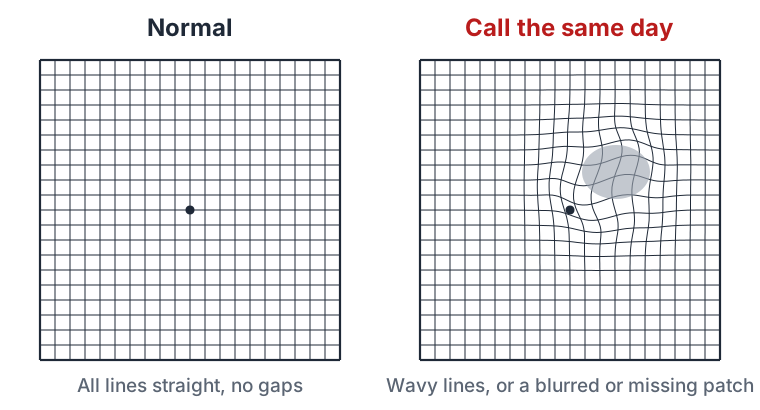
Call the same day if lines look wavy, bent or broken, or if a blurred or blank patch appears, and it is new. Keep a printed grid on the refrigerator door, where you will see it. Print the grid above opens a page with just the grid and these instructions.
Who gets it
- Age is the main factor: it is uncommon before 55
- Family history
- Smoking, which roughly doubles the risk and is the one large factor you can change
- Fair skin and light-colored eyes; high blood pressure and heart disease
What helps dry AMD
- Stop smoking.
- AREDS2 vitamins. For people with intermediate dry AMD, or advanced AMD in one eye, a specific vitamin and mineral formula (labelled "AREDS2") lowers the chance of progressing to advanced disease by about a quarter. It does not help early AMD or prevent AMD, and ordinary multivitamins are not the same thing. Ask your doctor whether you are at the stage where it helps.
- Diet: leafy green vegetables and fish.
- Sunglasses and a hat outdoors.
- Regular dilated exams, with a scan of the macula (OCT), and the Amsler grid at home.
- For advanced dry AMD (geographic atrophy), injections that slow the spread of the damaged area are now available. They do not restore vision, and they are worth discussing with a retina specialist.
Treating wet AMD
Wet AMD is treated with injections into the eye of medicines that stop the abnormal vessels from growing and leaking. Treatment starts with an injection every month or so, and the interval is then stretched as far as the eye allows. Most people keep the vision they had when treatment began, and about a third gain vision. Treatment is usually needed long term, and missing visits lets the leak return.
Living with vision loss
Good lighting, magnifiers, large-print and high-contrast settings, audiobooks and screen readers all help, and a low-vision specialist can match the tools to what you want to do. Because side vision is kept, people with AMD remain able to get around independently.
Questions worth asking
- Is my macular degeneration dry or wet, and what stage?
- Should I take AREDS2 vitamins?
- How often should my eyes be checked and scanned?
- What exactly should make me call?