Choosing a Lens Implant
Published · Updated
In cataract surgery the cloudy natural lens is replaced by a clear artificial one, an intraocular lens or implant. The implant stays in the eye for life. Its type and its power are chosen before surgery, and together they decide what you will see clearly without glasses afterward: far, arm's length, near, or some of each.
Choose a lens below to see three everyday distances through it. Turn on At night to see halos around lights, and This eye has astigmatism to see what a toric lens corrects.
The comparison needs JavaScript. Each kind of lens is described in words below.
The pictures show the usual pattern for each kind of lens, for illustration. Results vary from eye to eye, and your surgeon will tell you what to expect for yours.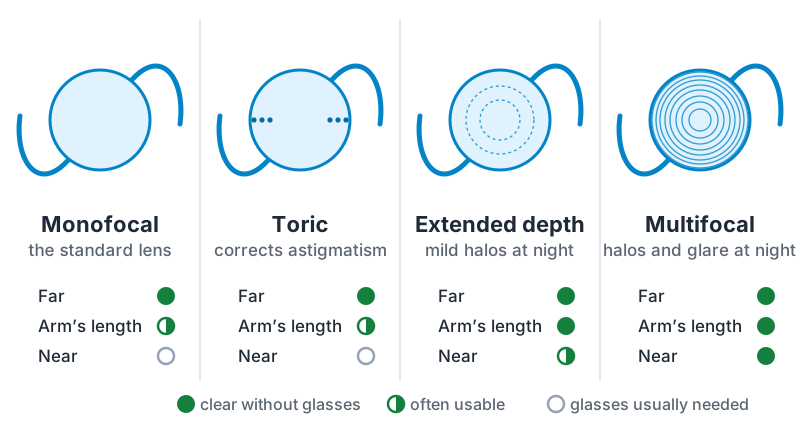
Monofocal lenses
A monofocal lens focuses at one distance. It is the standard lens, the one most people receive, and it is usually covered by insurance. Vision at its set distance is very sharp and high in contrast, and it gives the fewest problems with glare at night.
- Set for distance, the most common choice: driving, television and faces across a room are clear without glasses. Reading glasses are needed for near, and arm's length (a computer or the car dashboard) is usable but softer.
- Set for near: reading is clear without glasses, and glasses are worn for distance. Some people who have been nearsighted all their lives, and are used to reading without glasses, prefer this.
Monovision
Monovision uses monofocal lenses with one eye set for distance and the other for near (or arm's length). The brain learns to use whichever eye is clear for the task. Many people get through most of the day without glasses. The trade-offs are slightly less depth perception and a little less sharpness with both eyes together, and glasses may still help for night driving or long reading. It suits people who have used monovision with contact lenses before, and it is often tried with contact lenses first.
Toric lenses
Astigmatism means the front of the eye is curved more like a football than a basketball, which smears vision in one direction. A toric lens has astigmatism correction built in. It has small marks at its edge so the surgeon can turn it to line up with your astigmatism. Without it, an eye with significant astigmatism would need glasses for clear distance vision even after surgery.
Toric versions exist of most kinds of lens, including extended depth and multifocal lenses, and are used whenever one of those is chosen for an eye with significant astigmatism, since leaving the astigmatism would undo much of the benefit. A toric lens can occasionally rotate in the first weeks and need a small procedure to turn it back.
Extended depth of focus lenses
An extended depth of focus (EDOF) lens stretches the range of clear vision from distance to arm's length. Most people can drive, use a computer and see a dashboard without glasses, and use light reading glasses for small print. Some notice mild halos or glare around lights at night.
Multifocal lenses
A multifocal lens (bifocal or trifocal) splits light between distances using fine rings on its surface, so far, arm's length and near can all be usable without glasses. They give the most freedom from glasses, with trade-offs:
- Halos or rings around lights at night, and sometimes glare. Most people adapt over months, but some remain bothered.
- Slightly less contrast, because the light is shared. This matters in dim light, and it matters more when the eye has another condition that reduces contrast.
- They depend on a healthy eye. A multifocal lens works best when the cornea, the macula and the optic nerve are healthy.
When a simpler lens is wiser
A monofocal or toric lens is usually recommended when the eye has, or is likely to develop, a condition that reduces contrast or affects the center of vision:
- Glaucoma, especially moderate or advanced, since glaucoma already lowers contrast and future visual field tests are easiest to interpret with a monofocal lens. Extended depth lenses are sometimes considered in mild, stable glaucoma.
- Macular degeneration, diabetic eye disease or a membrane on the retina
- Significant dry eye or corneal disease such as Fuchs dystrophy or keratoconus
- Previous laser vision correction (LASIK or PRK), where the lens power is harder to predict
- A lot of night driving, or work that needs the sharpest possible contrast
How the power is chosen
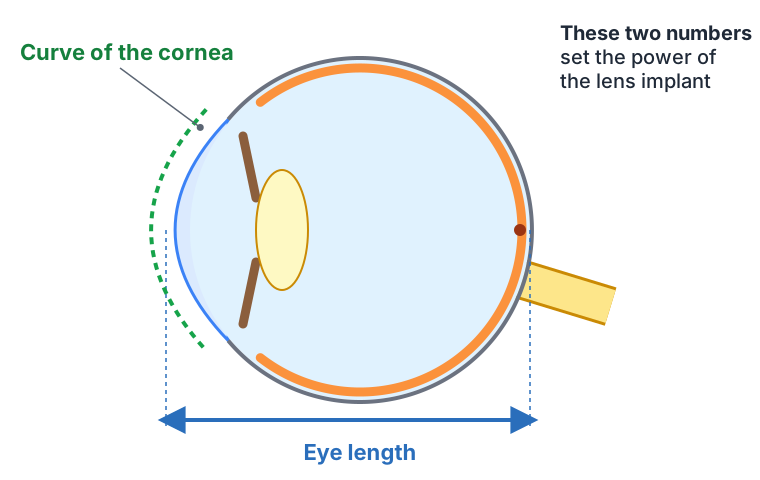
Measurements taken before surgery, mainly the length of the eye and the curve of the cornea, go into formulas that pick the implant's power. They are very accurate, but not perfect: a small difference from the target is common and is corrected with glasses. The measurements are less certain after LASIK or with a very long or short eye. Contact lenses change the shape of the cornea, so you may be asked to leave them out for some days before measuring. Preparing for Cataract Surgery covers this and the rest of the lead-up.
Glasses afterward
Even with the best result, most people use glasses for something: reading glasses with a monofocal lens, or glasses for fine print, night driving or long computer work with the others. Your final prescription is checked about a month after surgery, once the eye has settled.
Cost
In the United States, a standard monofocal lens is covered by Medicare and most insurance. Toric, extended depth and multifocal lenses usually carry an extra out-of-pocket charge, because they are aimed at reducing the need for glasses. Ask for the cost in advance.
Questions worth asking
- Which lenses are a good fit for my eyes, and which would you avoid?
- Do I have enough astigmatism for a toric lens to help?
- Would monovision suit me, and could I try it with contact lenses first?
- What will I still need glasses for with each option?
- What would the lens cost me?