Laser Iridotomy
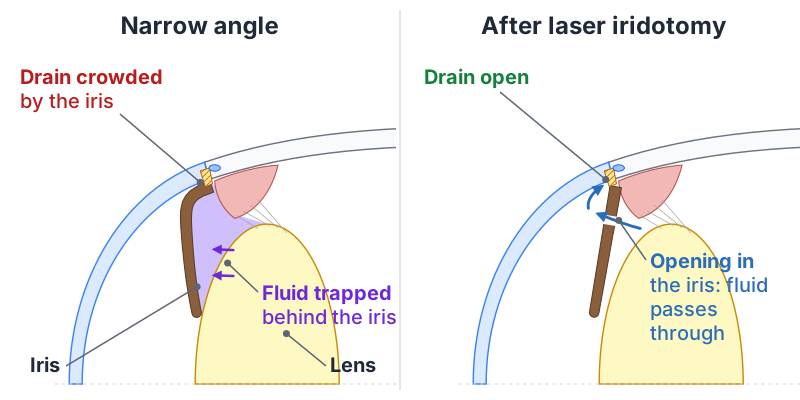
Laser peripheral iridotomy (LPI) is an office procedure for eyes with a narrow drainage angle. The laser makes a tiny opening in the outer edge of the iris, the colored part of the eye. That gives the fluid inside the eye a second path forward, which lets the iris fall back and uncovers the eye's drain. It takes a few minutes, is done at a laser that looks like the slit lamp used for your exams, and has no cuts or stitches.
Press Fire laser to see what happens inside the eye.
The animation needs JavaScript. The picture and the explanation below cover the same thing.
Why a narrow angle matters
Fluid is made behind the iris, flows forward through the pupil, and leaves through the drain (the trabecular meshwork) in the angle where the iris meets the cornea. What Is Glaucoma? has a picture of this path.
In some eyes, often smaller or farsighted eyes, and more so as the lens thickens with age, the iris sits close against the lens. Fluid has trouble getting through the pupil, so it builds up behind the iris and pushes it forward, like wind filling a sail. The bowed iris crowds the drain. This is called pupillary block, and it is the usual reason an angle is narrow.
A narrow angle can cause trouble in two ways:
- Suddenly. The iris can block the drain completely, and eye pressure rises within hours. This is an acute angle-closure attack: a red, painful eye, blurred vision, halos around lights, headache and nausea. It is an emergency and can damage the nerve quickly.
- Slowly. The iris can lean on the drain on and off for years, scarring it shut a little at a time and raising pressure with no symptoms at all.
How the laser helps
The opening is in the outer iris, usually near the top where the upper eyelid covers it, and it is smaller than a pinhead. Fluid passes through it, the pressure in front of and behind the iris evens out, and the iris flattens. In most eyes the angle opens wider, and a sudden attack from pupillary block is no longer possible.
The laser does not improve vision, and it is not a treatment for cataract. It is preventive: it protects the drain and the optic nerve.
Why your doctor might suggest it
- Your angle is narrow or partly closed on gonioscopy (the mirrored-lens exam of the drain), especially with raised pressure, scarring in the angle or nerve damage
- You have had an angle-closure attack; the other eye is then treated too, because it is at high risk
- You have symptoms of on-and-off closure, such as aching and halos in dim light
- Your angle is narrow and you need frequent dilation, or take medicines that can narrow it further
Not every narrow angle needs a laser. A large study (the ZAP trial) found that eyes with narrow angles but no other problems had a low risk of an attack over many years, so for some people careful watching is reasonable. Your doctor weighs how narrow the angle is, your pressure, the nerve, and your circumstances.
Cataract surgery is the other way to open a narrow angle. The natural lens is thick and the implant that replaces it is thin, which makes much more room. If you have a cataract that is ready, or higher pressure with angle closure, your doctor may recommend lens surgery instead of, or after, the laser.
The visit
- Drops are placed in the eye: one to make the pupil small, which stretches and thins the iris, one to prevent a pressure rise, and a numbing drop. The pupil drop can cause a brow ache and dim, blurry vision for a few hours.
- You sit at the laser with your chin and forehead on the rests.
- A contact lens is placed on the eye to hold the lids open and focus the laser. You may feel light pressure from it.
- The doctor applies the laser, usually a few pulses. Each one is a bright flash with a click, and you may feel a quick pinch or snap. It is over in a minute or two.
- Your pressure is checked 30 to 60 minutes later, before you leave.
Often both eyes need treatment. They may be done on the same day or on separate visits. Bring a driver: the drops blur your vision for several hours.
After the laser
- Blurred vision for the rest of the day is expected, from the drops, the gel used with the contact lens and a little pigment released by the laser.
- A mild ache, redness or light sensitivity for a day or two is common. Over-the-counter pain relievers help.
- You will usually use an anti-inflammatory drop for several days. Keep using any glaucoma drops unless you are told to stop.
- There are no activity restrictions. You can read, watch television, bathe and exercise.
- At a follow-up visit the doctor checks that the opening is clear and looks at the angle again with the mirrored lens.
Call the same day if you have severe eye pain, a marked drop in vision, a very red eye, or nausea with eye pain.
Risks
Laser iridotomy is a safe procedure, and serious problems are rare.
- A temporary rise in eye pressure in the first hours. This is why a preventive drop is used and pressure is checked before you leave.
- A small bleed at the laser spot is common. It stops within seconds with gentle pressure from the contact lens and clears on its own.
- Inflammation is mild and treated with the drops.
- Glare, a line or a ghost image from light entering through the new opening happens in a small number of people. It often fades as the brain adapts.
- The opening can close in the first weeks, rarely, and the laser is then repeated.
- The angle may stay narrow in some eyes, because pupillary block is not the only cause. You may still need drops, another laser or lens surgery, which is why follow-up matters.
- The laser may bring on a cataract slightly sooner. Damage to the cornea or retina is rare.
Medicines with a glaucoma warning
Many cold, allergy, sleep, bladder and stomach medicines carry a warning for people with "narrow-angle glaucoma", because they can widen the pupil and set off an attack in an eye at risk. After a working iridotomy these medicines are generally safe to take. Ask your eye doctor to confirm this for your eyes, and tell your other doctors and pharmacist that you have had the laser.
Questions worth asking
- How narrow is my angle, and is there any damage so far?
- Is the laser to prevent a problem, or to treat one that has started?
- Would cataract surgery be a better choice for me?
- Do both eyes need it?
- Are my current medicines safe to take before and after the laser?
- Will I still need drops or regular checks afterward?