Glaucoma Suspect and Ocular Hypertension
Published
Being told you are a glaucoma suspect means something about your eyes raises the question of glaucoma, but there is no proof of damage to the optic nerve. It is one of the most common reasons people are sent to a glaucoma specialist. Most glaucoma suspects never lose vision from glaucoma. The point of the label is to keep watching, so that if damage does start it is found early, when treatment works best.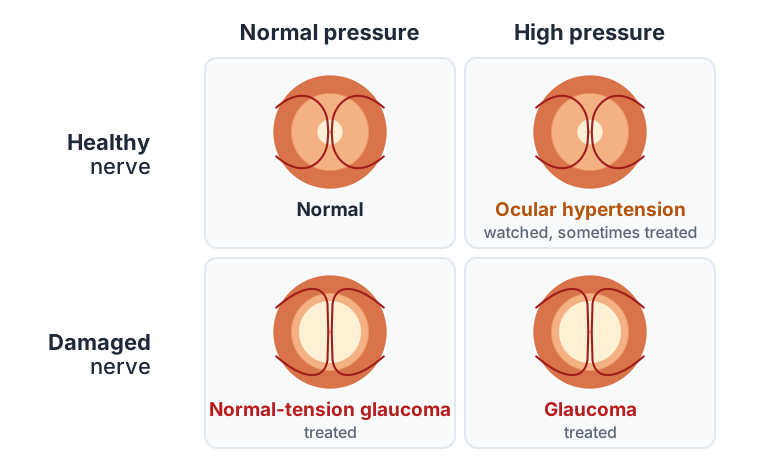
What makes someone a suspect
One or more of these, without definite damage:
- Higher eye pressure than usual (ocular hypertension, below)
- An optic nerve that looks suspicious, such as a large central cup. Some people are simply born with large cups, and their nerves stay the same for life.
- Borderline test results, on the OCT scan or the visual field, that might be early change or might be normal variation
- A strong family history of glaucoma
- Signs that can lead to glaucoma later, such as pigment or flaky material in the drain (see Other Types of Glaucoma)
A narrow drainage angle is a related but separate situation, covered on Narrow Angles and Angle Closure.
Ocular hypertension
Ocular hypertension means the eye pressure is above the usual range, typically over 21 mm Hg, while the optic nerve and visual field are healthy. It is common, and it is not glaucoma. It is a risk factor: the higher the pressure, the more likely glaucoma becomes over time.
A large trial, the Ocular Hypertension Treatment Study, followed people with ocular hypertension for years. Over five years about 1 in 10 of those who were only watched developed early glaucoma, compared with about 1 in 20 of those treated with pressure-lowering drops. So most people with ocular hypertension did not develop glaucoma even untreated, and treatment roughly halved the risk for those who would have.
The chance is higher with:
- Higher pressure
- A thinner cornea (measured with a quick painless test)
- Older age
- A larger cup in the optic nerve
- Glaucoma in a parent, brother or sister
To treat or to watch
There is no single right answer, and it is a decision you make with your doctor. Many people are watched without treatment. Treatment is more likely to be suggested when the pressure is high, when several risk factors add up, when only one eye works well, or when it would be hard to keep up regular follow-up.
If treatment is chosen, it is the same as for early glaucoma: a pressure-lowering drop or SLT laser. The aim is a modest drop in pressure, not the lowest possible.
What the follow-up looks like
The visits are about looking for change over time, so the same tests are repeated:
- Eye pressure, sometimes at different times of day
- A look at the optic nerve, with photographs
- OCT scans of the nerve fiber layer
- Visual field tests
- Corneal thickness and a look at the drainage angle, usually once
Expect testing more often at first, to set a baseline, and then about once or twice a year if things stay stable. Glaucoma Testing explains each test. If nothing changes over years, the visits can often be spaced out.
What you can do
- Keep the appointments, even though nothing feels wrong. Early glaucoma has no symptoms.
- Tell your doctor about family members with glaucoma, and let them know they should be checked.
- Mention steroid use, including inhalers, creams and injections, since steroids can raise eye pressure.
- If you are treated, use the drops every day, and tell your doctor about side effects rather than stopping.
Questions worth asking
- What makes me a glaucoma suspect: the pressure, the nerve, my tests or my family history?
- How likely am I to develop glaucoma, in your estimate?
- Would treatment help me now, or is watching reasonable?
- How often should I be tested?