Glaucoma Eye Drops
Published
Drops are the most common treatment for glaucoma. Every glaucoma drop lowers eye pressure, but the families work in different ways and have different side effects. Knowing which family each of your drops belongs to makes it easier to use them correctly, notice side effects and tell your doctors what you take.
Technique, timing and storage are on Using Eye Drops. Photos of each bottle are in the Eye Medication Reference.
Where each drop works
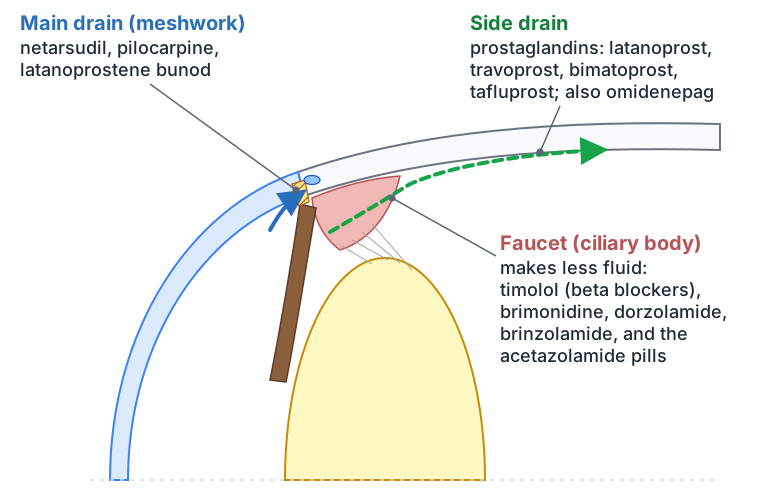
The eye pressure sink shows the same idea: turn down the faucet, or open the drains. Drops from different families add to each other better than two from the same family.
Prostaglandins
Examples: latanoprost (Xalatan), travoprost (Travatan Z), bimatoprost (Lumigan), tafluprost (Zioptan, in single-use vials). Latanoprostene bunod (Vyzulta) is a relative that also works on the main drain.
- What they do: open the side drain. They lower pressure the most of any single drop, and are often the first drop prescribed.
- How often: once a day, usually in the evening.
- Cap: teal (turquoise).
- Side effects: red eyes, especially in the first weeks; longer, darker, thicker eyelashes; darkening of the skin of the eyelids; in some light-colored eyes, a slow, permanent darkening of the iris; and, with long use, a hollow look around the eye from loss of the fat behind it. Using the drop only in the eye that needs it, and wiping off any that runs onto the lids, helps.
Omidenepag (Omlonti) works on the side drain in a different way. It is used once a day and is less likely to change lashes or eyelid color.
Beta blockers
Examples: timolol (Timoptic, Betimol and others), carteolol, betaxolol.
- What they do: make the eye produce less fluid.
- How often: once or twice a day.
- Cap: yellow, or blue for some strengths.
- Side effects: usually few in the eye. Absorbed into the body, they can slow the heart rate, cause tiredness or low mood, and worsen asthma or COPD. They are usually avoided in people with asthma, some heart rhythm problems or a very slow pulse. Pressing on the inner corner of the eye after the drop reduces how much reaches the body.
Alpha agonists
Examples: brimonidine (Alphagan P and generics). Apraclonidine (Iopidine) is used short term, often around laser treatment.
- What they do: reduce fluid, and help the side drain a little.
- How often: two or three times a day.
- Cap: purple.
- Side effects: an allergic reaction with red, itchy, puffy eyes is common and can start months after beginning the drop. Dry mouth and tiredness can occur. Brimonidine is not used in infants and young children.
Carbonic anhydrase inhibitors
Examples: dorzolamide (Trusopt) and brinzolamide (Azopt), and the pills acetazolamide (Diamox) and methazolamide.
- What they do: reduce fluid.
- How often: two or three times a day.
- Cap: orange.
- Side effects of the drops: stinging (dorzolamide), brief blurring (brinzolamide, a milky suspension; shake it first), and a bitter taste. Tell your doctor if you are allergic to sulfa medicines.
- The pills are stronger and are mostly used short term, for example before surgery or during a pressure spike. They can cause tingling in the hands and feet, tiredness, frequent urination, a metallic taste that makes carbonated drinks taste flat, and, with long use, kidney stones.
Rho kinase inhibitor
Example: netarsudil (Rhopressa).
- What it does: relaxes the main drain so fluid leaves more easily, and lowers the pressure in the veins it drains into.
- How often: once a day, in the evening.
- Cap: white.
- Side effects: red eyes are common, and small red spots on the white of the eye can appear; both are harmless. Faint whorl-shaped deposits on the cornea can develop and usually do not affect vision.
Pilocarpine
Pilocarpine opens the main drain by contracting the muscle behind the iris. It was once a mainstay but is used less now, because it is needed three or four times a day and makes the pupil small, which dims vision and can cause a brow ache. It still has a role in some eyes with narrow angles.
Combination drops
Two drugs in one bottle mean fewer drops, fewer five-minute waits and less preservative on the eye:
- Dorzolamide and timolol (Cosopt): blue cap; also available preservative-free
- Brimonidine and timolol (Combigan): blue cap
- Brinzolamide and brimonidine (Simbrinza): light green cap, and no beta blocker
- Netarsudil and latanoprost (Rocklatan): white cap, once in the evening
Preservatives
Most bottles contain a preservative, usually benzalkonium chloride. Used for years, especially with several drops, it can irritate the surface of the eye and cause burning and redness. If your eyes are sore, ask about preservative-free versions, combination drops, or SLT laser to reduce the number of drops. Treating Dry Eye covers the surface itself.
A few rules for every glaucoma drop
- Use it every day. Drops control pressure only while they are being used. Missing doses is one of the main reasons glaucoma gets worse.
- Do not stop a drop on your own. If it causes side effects, call; there is nearly always an alternative.
- Wait five minutes between different drops. The Eye Drop Schedule Builder lays out a routine.
- Tell all your doctors and your pharmacist which drops you use. Beta blockers in particular can interact with heart and breathing problems and medicines.
- Cost: most have generic versions. If a drop is too expensive, say so; there is usually a cheaper alternative.
Questions worth asking
- Which family does each of my drops belong to?
- How much should each one lower my pressure?
- Could a combination drop or a preservative-free version suit me better?
- Would laser let me use fewer drops?