Flashes and Floaters
Floaters are the specks, threads and cobwebs that drift across your vision, easiest to see against a bright sky or a white page. Flashes are brief streaks or arcs of light at the edge of vision, like a camera flash or lightning, often noticed in the dark. Both are very common and usually harmless. A sudden change in either one, though, can be the first sign of a tear in the retina, and that needs to be checked the same day.
Press Play to see where they come from.
The animation needs JavaScript. The explanation below covers the same thing.
Where they come from
The eye is filled with a clear gel called the vitreous. In youth it is firm, like set gelatin, and attached to the retina, the light-sensing layer lining the back of the eye.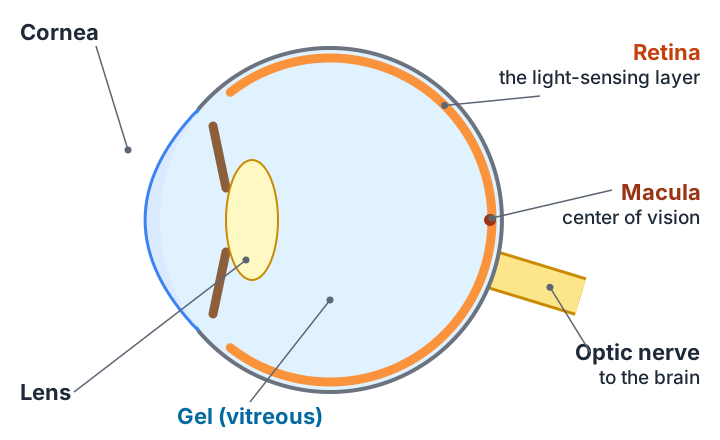
- Floaters are clumps and strands that form in the gel as it turns more watery with age. They cast shadows on the retina. They move when your eye moves and drift on for a moment after it stops.
- Flashes happen when the gel tugs on the retina. The retina can only signal light, so a pull is seen as a flash.
When the gel pulls away
At some point, usually between 50 and 70, the shrinking gel peels away from the back of the eye. This is a posterior vitreous detachment. It happens to most people eventually, sooner in those who are nearsighted or have had cataract surgery or an eye injury. It typically brings:
- A new floater, often a large one shaped like a ring, a cobweb or a fly
- Flashes at the outer edge of vision, especially in the dark or when the eyes move
- These settle over weeks to a few months as the gel comes fully free
In most people the gel separates cleanly and nothing more happens. In some, about one in seven people who are seen for new flashes or floaters, it tears the retina as it goes. A tear lets fluid get under the retina and can lead to a retinal detachment. A tear found early is sealed with a few minutes of laser in the office.
That is why new flashes or floaters should be examined promptly, with the pupils dilated, even though the cause usually turns out to be harmless. You cannot tell the harmless kind from a tear by how it looks to you.
Call the same day if
- A sudden shower of many new floaters, like pepper or a swarm of gnats
- Repeated new flashes
- A shadow, curtain or veil at the edge of your vision
- A sudden drop in vision
See When to Call the Same Day. A few floaters that have been there for years and have not changed are not urgent.
The exam
Your pupils are dilated with drops so the doctor can see the whole retina, out to its edges, where tears occur. The doctor may press gently on the eyelid with a small instrument to bring the edge into view. If blood in the gel hides the retina, an ultrasound scan is used. Because a tear can appear a little later, you may be asked to return for a second look in a few weeks, and sooner if anything changes.
Living with floaters
- They become less noticeable over months as they sink below the line of sight and the brain learns to ignore them.
- Looking up and down quickly can swirl a floater out of the way for a moment.
- Surgery to remove the gel, and laser to break up floaters, exist but carry real risks. They are considered only for the rare floaters that seriously interfere with vision after many months.
To see what floaters look like to someone else, try "Floaters" in the vision loss simulator.
Questions worth asking
- Has the gel separated completely, and is the retina intact?
- Do I need a second exam, and when?
- Am I at higher risk of a tear in my other eye?