Treating Dry Eye
Dry eye is usually a long-term condition, and treatment is built up in steps. Most people do well with the first two or three. The aim is comfortable eyes and steady vision, with a routine you can keep up.
Step 1: Your surroundings and habits
- Blink. When reading or using a screen, look away every 20 minutes and blink fully several times.
- Lower your screen so you look slightly down at it. The lids then cover more of the eye.
- Keep moving air off your face: turn car vents away, and avoid sitting under a fan or air vent.
- Add moisture with a humidifier in dry or heated rooms.
- Wraparound glasses outdoors keep wind off the eyes.
- Review your medicines with your doctor. Do not stop a prescription on your own.
Step 2: Artificial tears
Artificial tears add moisture and smooth the surface. They are sold without a prescription.
- Use them regularly, not only when the eyes hurt. Three or four times a day works better than waiting for a bad moment.
- Preserved tears, in an ordinary bottle, are fine up to about four times a day.
- Preservative-free tears, in single-use vials or special bottles, are better if you need them more often than that, or if your eyes are sensitive. The preservative itself can irritate the eye with frequent use.
- Gel drops are thicker and last longer, and blur vision for a minute or two.
- Ointment at bedtime protects the eye overnight. It blurs vision, so it is used just before sleep.
- Avoid "get the red out" drops. They shrink blood vessels and do not treat dryness, and the redness often returns worse.
Choosing Artificial Tears helps you pick a kind, and brands and photos are in the Eye Medication Reference. If you use several drops, the Eye Drop Schedule Builder can lay out a daily routine; leave five minutes between different drops.
Step 3: Eyelid care
Most dry eye involves the oil glands in the eyelids, so warm compresses and lid cleaning are part of treatment for most people. How to do them is on Blepharitis and the Eyelid Glands.
Step 4: Prescription drops
These treat the inflammation that keeps dry eye going. They are for long-term use, and most take weeks to months to show their full effect, so they need a fair trial.
- Cyclosporine (Restasis, Cequa, Vevye) and lifitegrast (Xiidra), used twice a day, calm inflammation on the surface of the eye and help it make more of its own tears. They can sting for the first weeks.
- Perfluorohexyloctane (Miebo), used four times a day, forms a layer over the tears that slows evaporation. It is aimed at dry eye from poor oil.
- A short course of a steroid drop such as loteprednol (Eysuvis) settles a flare quickly. Steroids are kept short because with long use they can raise eye pressure and cause cataract, which matters especially if you have glaucoma.
- A nasal spray (varenicline, Tyrvaya) that stimulates natural tear production is an option for people who cannot tolerate drops.
Step 5: Keeping your own tears
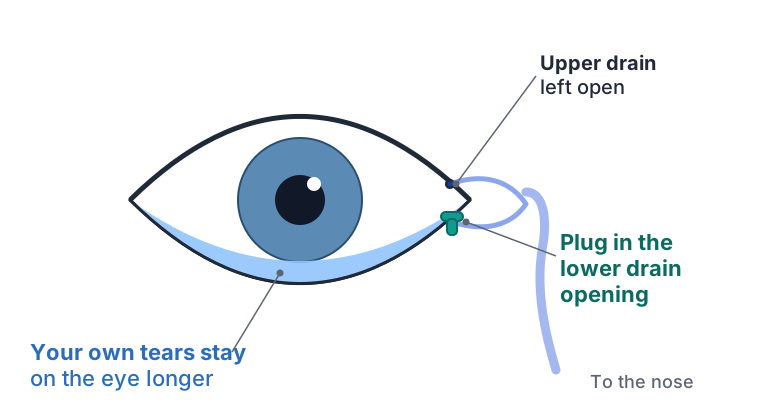
Tears drain through a small opening at the inner corner of each lid. A punctal plug is a tiny plug placed in that opening in the office, in a few seconds, so your own tears stay on the eye longer. Some dissolve over months; others stay until removed. You may feel it at the corner of the lid for a day or two. Plugs help most when the problem is too few tears. Press Play to see how one works.
The animation needs JavaScript. The picture below shows the same thing.
Further steps for severe dry eye
- Serum tears, eye drops made from your own blood, which contain natural healing factors
- In-office treatments for the oil glands that warm and express them, or light-based treatment
- Special contact lenses (scleral lenses) that hold a layer of fluid against the eye
- Treatment of an underlying condition, sometimes together with a rheumatologist
- Small procedures to close the drain openings permanently, or to help lids that do not close fully
What to expect
Dry eye improves slowly, over weeks, and tends to have good and bad spells with the seasons, illness and long days at a screen. The routine that works is the one you keep doing when your eyes feel fine. Let your doctor know if a treatment stings too much to use or is not helping after a couple of months; there is usually another option.
If you also have glaucoma
Glaucoma drops, especially several with preservatives, are a common cause of a sore, dry surface. Options include preservative-free versions, combination drops that cut the number of bottles, or SLT laser to reduce the drops needed. Tell your doctor about burning or redness, and keep using your glaucoma drops meanwhile.
Questions worth asking
- Which step am I on, and what comes next if this is not enough?
- Should my tears be preservative-free?
- How long before I should expect this prescription to help?
- Would punctal plugs suit my kind of dry eye?