Corneal Transplants
A corneal transplant replaces diseased cornea with healthy tissue from a donor. It is the most common and most successful transplant in medicine: the cornea has no blood vessels of its own, so the body is less likely to reject it than other transplanted tissue. No matching of blood or tissue type is needed, and anti-rejection pills are not usually required, only drops.
Today, where possible, only the diseased layer is replaced. Transplants are done by a cornea specialist; your eye doctor will refer you if one is needed.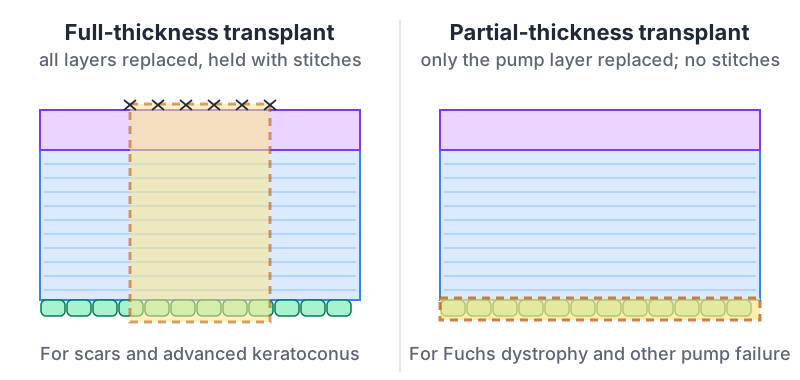
Why one might be needed
- Fuchs dystrophy and other failure of the cornea's pump cells, including after earlier eye surgery
- Keratoconus too advanced for contact lenses
- Scars from infection or injury
- An earlier transplant that has failed
The kinds of transplant
- Partial-thickness, inner layer (DMEK or DSAEK). Only the pump layer on the inside of the cornea is replaced, through a small incision. A gas bubble holds the new layer in place while it attaches. There are no stitches in the cornea, vision recovers in weeks to a few months, and rejection is uncommon. This is the standard operation for Fuchs dystrophy.
- Partial-thickness, outer layers (DALK). The front layers are replaced and your own pump cells are kept, which lowers the risk of rejection. It is used for keratoconus and for scars that do not reach the inner layer.
- Full-thickness (penetrating keratoplasty, PK). A round button of all layers is replaced and held with very fine stitches. It is used when every layer is affected.
The operation
It is an outpatient procedure of about one to two hours, under local anesthetic with sedation or a general anesthetic. It is often combined with cataract surgery.
After an inner-layer transplant you lie flat on your back, face up, for much of the first one to three days, so the gas bubble floats against the new layer and presses it in place. Sometimes more gas has to be added in the office during the first weeks.
Recovery
- Partial-thickness, inner layer: vision is blurred while the bubble is present, then improves over weeks, and is usually stable by three months.
- Full-thickness: healing is slow. Vision takes six months to a year or more to settle. Stitches are removed gradually over months to years, and glasses or a rigid contact lens are often needed for the astigmatism that results.
- Steroid drops are used for many months, and often a low dose indefinitely, to prevent rejection. The schedule matters; do not stop them without being told to.
- A shield at night for the first weeks, and no rubbing, ever. A full-thickness transplant never regains the full strength of a normal cornea, so protective eyewear is important for sport and manual work.
Rejection
The body can recognise the donor tissue and attack it, most often in the first two years but possibly much later. Caught early, most rejection episodes are reversed with intensive steroid drops. Know the warning signs, remembered as RSVP:
- Redness
- Sensitivity to light
- Vision getting worse
- Pain
Call the same day if any of these lasts more than a day, at any time after a transplant, however many years later. See When to Call the Same Day.
Other risks
- Raised eye pressure and glaucoma, partly from the long-term steroid drops. Pressure is checked at every visit, and people who already have glaucoma are watched closely. Glaucoma is one of the main reasons a graft fails over time.
- The new layer not attaching after an inner-layer transplant, treated by adding more gas.
- Infection, bleeding, and cataract.
- The graft wearing out over the years. A transplant can be repeated.
About the donor
Donor corneas come from people who chose to donate at death. The tissue is screened and tested by an eye bank. There is no waiting list of the kind there is for other organs.
Questions worth asking
- Which kind of transplant do you recommend for me, and why?
- Will I need to lie flat afterward, and for how long?
- How long will I be on steroid drops?
- How will my eye pressure be followed?