Corneal Infections
An infection of the cornea is called keratitis, and when it erodes into the cornea it is a corneal ulcer. It is one of the true emergencies in eye care: a bad infection can scar the cornea within a day or two. Treated early, most heal well. The most common cause in otherwise healthy people is contact lens wear.
Warning signs
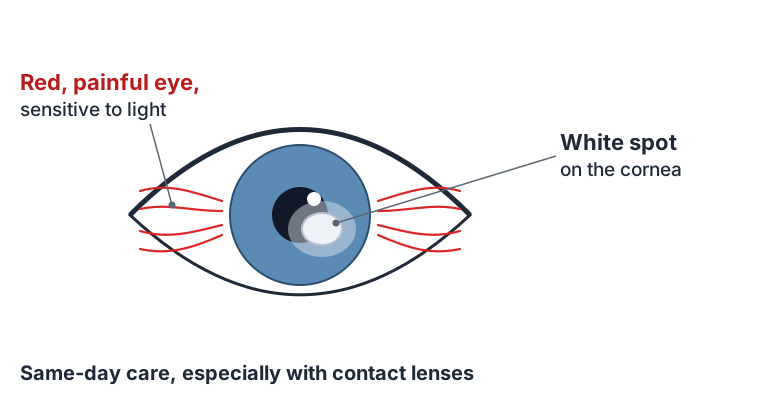
- Pain in the eye, often severe
- Redness
- Sensitivity to light
- Blurred vision
- Discharge or heavy watering
- A white or grey spot on the clear part of the eye
Call the same day. If you wear contact lenses, take them out, do not put them back in, and bring the lenses and the case with you. See When to Call the Same Day.
Contact lenses
A lens reduces the oxygen reaching the cornea and can carry germs against its surface for hours. The habits that cause most infections:
- Sleeping in lenses, even ones approved for it. This raises the risk several times over.
- Water. Showering, swimming or using a hot tub in lenses, or rinsing lenses or the case with tap water. Water carries an organism called acanthamoeba that causes a severe infection which is very hard to treat.
- Topping up old solution, or using saline or water as a disinfectant
- Wearing lenses longer than they are meant to be worn
- A dirty case. Replace it every three months.
Safer habits: wash and dry your hands first, rub and rinse lenses with fresh solution every time, let the case air-dry, take lenses out for sleep and water, and take them out at the first sign of redness or pain. Daily disposable lenses carry the lowest risk.
Bacterial and fungal infections
- Bacterial infections are the most common and can move fast. They are treated with strong antibiotic drops, at first as often as every hour around the clock.
- Fungal infections often follow an injury with plant matter, such as a branch or thorn. They develop more slowly and need weeks to months of antifungal drops.
- Your doctor may take a small sample from the ulcer to identify the organism.
- You are usually seen every day or two at first, until the infection is clearly improving.
Herpes in the eye
The cold sore virus (herpes simplex) can infect the cornea. It lives permanently in the nerve and can reactivate from time to time, usually in the same eye. It is not caught from someone else each time.
- A red, uncomfortable, light-sensitive eye, often with less pain than expected
- Treated with antiviral pills (acyclovir or valacyclovir) or antiviral drops or gel
- People with repeated episodes may take a low daily dose of an antiviral pill to prevent them, since each one can leave more scarring
- Steroid drops must not be used for a red eye unless an eye doctor has prescribed them: they can make a herpes infection of the surface much worse
Shingles around the eye
Shingles (herpes zoster) on the forehead, around one eye or on the tip of the nose can involve the eye itself. It causes a painful, blistering rash on one side of the face.
- Antiviral pills work best started within three days of the rash
- An eye exam is needed even if the eye feels fine, because inflammation inside the eye and raised eye pressure can follow
- The shingles vaccine, recommended from age 50, greatly lowers the risk
Treatment in general
- Use the drops exactly as prescribed, including overnight if you are asked to. In the first days, frequency is what clears the infection.
- No contact lenses until you are told it is safe, and then start with a new pair and a new case.
- Pain relief by mouth, and sometimes a drop to relax the eye.
- Keep every follow-up visit, even if the eye feels better.
Afterward
Small ulcers away from the center heal with little or no effect on vision. A scar in the center can blur vision permanently. Options then include a rigid contact lens, laser treatment of the surface, or a corneal transplant.
Questions worth asking
- Do you know what kind of infection this is?
- How often do I use the drops, and do I wake at night for them?
- When should I be seen again?
- When, and how, can I go back to contact lenses?