Corneal Scratches
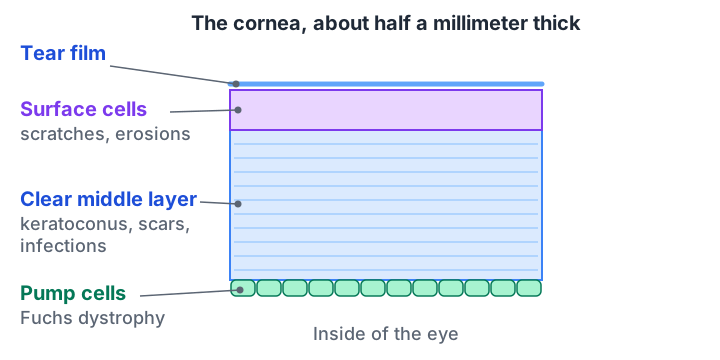
A corneal abrasion is a scratch on the surface of the cornea, the clear window at the front of the eye. It is one of the most common eye injuries and one of the most painful, because the cornea has more nerve endings than any other part of the body. The good news is that the surface heals faster than almost any other tissue, usually within a few days.
Press Play to see what happens.
The animation needs JavaScript. The explanation below covers the same thing.
The layers of the cornea
Common causes
- A fingernail, often a child's
- A branch, a leaf or the edge of a sheet of paper
- A makeup brush or mascara wand
- Sand, grit or sawdust, especially when the eye is rubbed
- A speck trapped under the upper eyelid, which scratches with every blink
- Contact lenses that are worn too long, damaged or dirty
What it feels like
- Sharp pain and the feeling that something is in the eye
- Watering and redness
- Strong sensitivity to light
- Blurred vision
- Difficulty keeping the eye open
What to do
- Rinse the eye with clean water or saline if something may be in it.
- Do not rub, and do not try to remove anything stuck to the eye.
- Take contact lenses out and leave them out.
- Be seen the same day. The eye needs to be checked for something still under the lid, for a deeper injury, and for infection.
- Go straight to an emergency room if the eye was struck at high speed (hammering, grinding, mowing), if something has pierced it, or if a chemical splashed in it. For a chemical, rinse first for at least 15 minutes. See When to Call the Same Day.
At the visit
A numbing drop makes the exam comfortable. A yellow-green dye shows the scratch clearly under blue light, and the upper lid is turned over to look for anything trapped beneath it.
Treatment
- Antibiotic drops or ointment for a few days, to prevent infection while the surface is open.
- Lubricating drops or ointment for comfort.
- Pain relief by mouth. A drop to relax the focusing muscle, or a soft "bandage" contact lens, is sometimes used for larger scratches.
- No contact lenses until your doctor says the eye is fully healed.
- Numbing drops are used only in the office. Used at home, they stop the cornea from healing.
- Patching is rarely used now; it does not speed healing.
Most scratches feel much better within a day and are healed in one to three days. You may be asked to return to confirm it.
Contact lens wearers
A painful red eye in a contact lens wearer is treated as an infection until proven otherwise. See Corneal Infections. Be seen the same day, and bring your lenses and case.
When it comes back: recurrent erosion
After a scratch, the new surface cells take weeks to anchor firmly. In some people the patch lifts off again weeks or months later, typically on opening the eyes in the morning, with the same sudden pain. This is a recurrent erosion.
- Ointment at bedtime for several months is the usual prevention. Salt-based (hypertonic) ointment draws fluid out and helps the cells stick.
- Do not rub the eyes on waking.
- For erosions that keep returning, an office procedure to smooth the surface, or a laser treatment, helps the cells anchor properly.
Questions worth asking
- Is anything still in the eye or under the lid?
- When can I wear my contact lenses again?
- Should I use ointment at night afterward, and for how long?