Cataract Surgery
A cataract is clouding of the eye's natural lens, which sits behind the pupil and focuses light onto the retina. Almost everyone develops some cataract with age; it becomes a problem when it blurs vision, dulls colors, causes glare from headlights or sunlight, or changes your glasses prescription frequently. Cataract surgery replaces the cloudy lens with a clear artificial one and is among the most common and successful operations performed.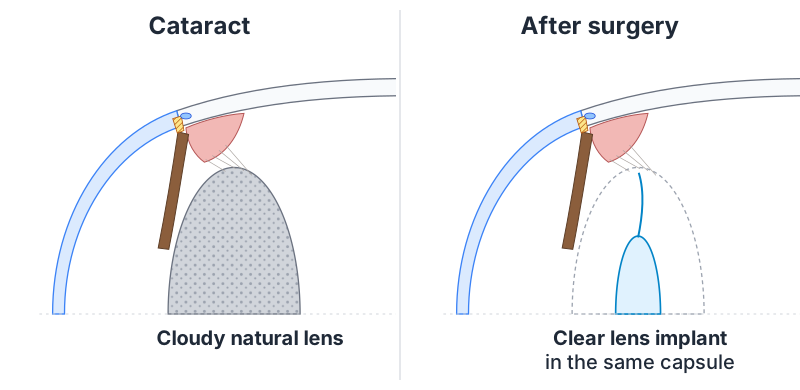
When to have surgery
There is no harm in waiting as long as the cataract is not interfering with your life, and no "ripeness" is required. Surgery makes sense when the cataract limits what you want to do: driving (especially at night), reading, recognising faces, or working. Two exceptions where your doctor may recommend not waiting: a cataract that is making glaucoma harder to control or the angle narrow, and a cataract so dense that it prevents the view of the retina or optic nerve needed to monitor other eye disease.
Lens implant choices
The artificial lens (intraocular lens, or IOL) is chosen for your eye using measurements taken before surgery.
- Monofocal lenses give clear vision at one distance, usually far, with reading glasses for near. This is the standard lens covered by insurance.
- Toric lenses correct astigmatism so that distance vision is sharper without glasses.
- Multifocal and extended-depth-of-focus lenses reduce the need for glasses at more than one distance, with trade-offs such as halos at night.
- Monovision sets one eye for distance and the other for near using monofocal lenses.
For patients with glaucoma, a monofocal or toric lens is usually recommended. Multifocal lenses reduce contrast, and glaucoma already reduces contrast sensitivity, so the combination can be disappointing.
Before surgery
Measurements of the eye's length and curvature are taken in the office to select the lens power. You may be asked to start an antibiotic or anti-inflammatory drop a day or two before, and to use nothing by mouth for several hours before surgery. Most medicines, including blood thinners, are continued; confirm with your surgeon. Tell the team if you take or have ever taken tamsulosin (Flomax) or similar prostate medicines, as they affect the iris during surgery and the surgeon plans for it.
The day of surgery
Surgery is at an outpatient surgery center. The eye is numbed with drops or gel and you are given light sedation; you are awake but relaxed and will not see the surgery itself, only lights and colors. Through an incision about two millimeters wide, the surgeon opens the front of the lens capsule, breaks the cloudy lens up with ultrasound and removes it, and places the folded implant into the capsule where it unfolds. The incision seals itself, usually without stitches. The operation takes about 10 to 20 minutes, and you are at the center for two to three hours in all. You go home with a shield and need a driver.
If a glaucoma procedure (MIGS) is planned at the same time, it is done through the same incision and adds a few minutes.
Recovery
Drops. Typically an antibiotic for a week, a steroid tapered over four weeks, and an anti-inflammatory (NSAID) for four weeks; some surgeons use a combination drop. The Post-Op Eye Drop Schedule tool prints this day by day. Continue your glaucoma drops in both eyes unless told otherwise.
Vision. Often noticeably better by the next day, though it can take a week or two to sharpen, and longer if MIGS was added. Colors look brighter and bluer, which can be striking. Glasses, if needed, are prescribed about four weeks after surgery once the eye is stable. The second eye, if needed, is usually done one to several weeks after the first.
Activity. Wear the shield at night for a week. Avoid rubbing the eye, swimming and hot tubs for two weeks, and avoid heavy lifting or bending with your head down for the first week. Reading, screens, walking and showering (keep soap out of the eye) are fine from the first day. Most people drive within a few days once vision allows.
Normal after surgery: scratchiness, mild ache, light sensitivity, a red patch on the white of the eye, and seeing an arc of light at the edge of vision for a few weeks.
Call the same day if
- Vision gets worse after initially improving
- Pain is increasing or severe
- Redness increases or there is discharge
- You see many new floaters, flashes of light, or a curtain over part of your vision
Cataract surgery and glaucoma
Removing the lens on its own lowers eye pressure slightly in many eyes, and more so in eyes with narrow angles, where the thinner implant opens the drain. Your pressure will be watched closely in the first weeks, because steroid drops can raise pressure in some glaucoma patients ("steroid responders") and the drops may be adjusted. If you have had a trabeculectomy, your surgeon plans the cataract operation to protect the bleb. Combining MIGS with cataract surgery is often the most efficient way to treat both conditions in one visit to the operating room.
Later on
Months or years after surgery, the capsule that holds the implant can become cloudy, blurring vision in a way that feels like the cataract coming back. This "secondary cataract" is treated in the office with a painless laser (YAG capsulotomy) that takes a minute and is permanent.
Questions worth asking
- Which lens do you recommend for me, and will I need glasses afterward?
- Should a glaucoma procedure be done at the same time?
- Which of my drops do I continue?
- When can I drive, and when will my second eye be done?