Narrow Angles and Angle Closure
Published
The fluid inside the eye leaves through a drain, the trabecular meshwork, in the angle where the iris meets the cornea. In most eyes the angle is wide open. In some it is narrow: the iris sits close to the drain and can block it. That is called angle closure, and it can raise the eye pressure slowly over years or suddenly over hours.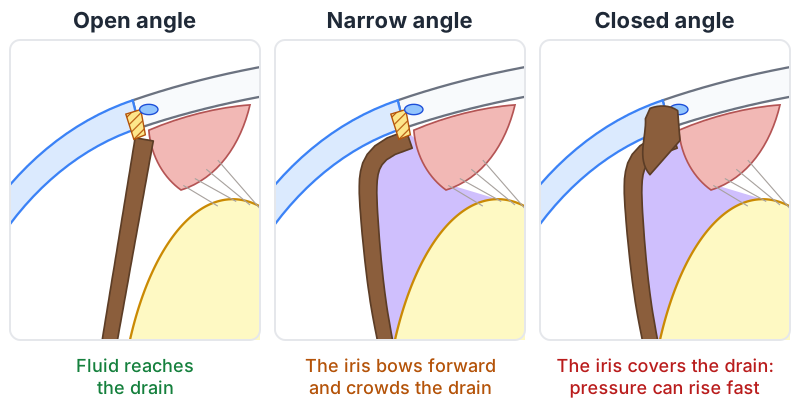
Narrow, closed, and angle-closure glaucoma
These are stages, and many people stay at the first one:
- Narrow angle (angle-closure suspect): the iris is close to the drain, but the pressure and the optic nerve are normal.
- Angle closure: the iris touches the drain in places, sometimes leaving scar tissue that seals it, or the pressure is raised.
- Angle-closure glaucoma: the optic nerve has been damaged.
Who has narrow angles
- People who are farsighted, or have small eyes
- Older adults: the natural lens thickens with age and pushes the iris forward
- Women, and people of East Asian or Inuit ancestry
- A family history of angle closure
Narrow angles cause no symptoms on their own. They are found at an eye exam, with gonioscopy, a mirrored contact lens that lets the doctor see the angle (see Glaucoma Testing), and sometimes with a scan of the front of the eye.
An acute attack
When the angle closes completely, pressure can rise within hours. Warning signs:
- A red, painful eye, often with a headache
- Blurred vision, and halos or rainbows around lights
- Nausea or vomiting
This is an emergency. Very high pressure can damage the optic nerve within hours. Contact an eye doctor at once, or go to an emergency room. See When to Call the Same Day.
Attacks are more likely when the pupil widens: in dim light, with dilating eye drops, or with medicines that widen the pupil, including many cold and allergy medicines, some medicines for bladder control, nausea or motion sickness, and some antidepressants. A few medicines, such as topiramate, can close the angles of both eyes in a different way. Milder, on-and-off closure can cause brief aching and halos in dim light that settle on their own; mention these to your doctor.
Treatment
Laser iridotomy. A quick office laser makes a tiny opening in the outer iris, so fluid can pass and the iris falls back from the drain. It is the usual first treatment, and the iridotomy page has an animation: Laser Iridotomy.
Lens surgery. The natural lens is thick, and the implant that replaces it is thin, so removing the lens opens the angle more than the laser does. A large trial (EAGLE) found that lens removal worked better than laser iridotomy for many people with angle-closure glaucoma or high pressure from angle closure. When a cataract is present, cataract surgery is often the treatment of choice.
Drops lower the pressure while the angle is being treated, and some people need them long term, especially if the drain has scarred.
Other options include a laser that pulls the outer iris back from the drain (iridoplasty), for an iris shape called plateau iris that the iridotomy does not fully fix, and glaucoma surgery when the pressure stays high.
Is treatment always needed?
No. A large study (the ZAP trial) found that people with narrow angles and nothing else wrong had a low risk of an attack over many years, so careful watching is a reasonable choice for some. Your doctor weighs how narrow the angles are, the pressure, the nerve, your symptoms and your circumstances.
Living with narrow angles
- Tell every doctor and pharmacist that you have narrow angles, or have had an iridotomy, before starting a new medicine.
- Dilation at eye exams is often still possible, sometimes after the laser, and your eye doctor will decide.
- Know the warning signs above, and act on them the same day.
- Ask family members to have their angles checked.
Questions worth asking
- How narrow are my angles, and has the drain been damaged?
- Do I need a laser, lens surgery, or watching?
- Are any of my medicines a risk for me?
- Is it safe to dilate my eyes?