Patient information
SLT Laser
An office laser that lowers eye pressure by treating the eye's drain. It takes a few minutes, with no cuts or stitches.
Scan for the full page, with an animation
What it does
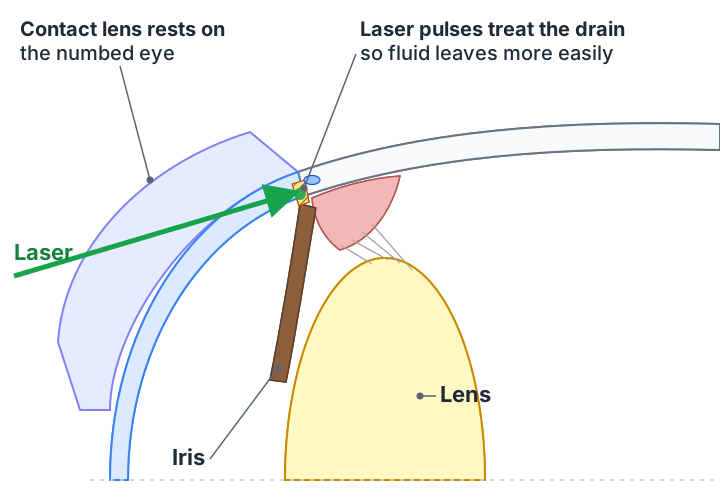
Selective laser trabeculoplasty (SLT) treats the eye's drain with short, gentle pulses of light. Over four to six weeks the drain works better and the pressure falls, on average by about as much as one drop. It can be a first treatment instead of drops, or added to them. The effect can wear off over years, and it can usually be repeated.
The visit
- A numbing drop and a drop to prevent a pressure rise are placed in the eye.
- Standard SLT: a contact lens rests on the eye and the laser is applied around the drain over a few minutes. You see flashes and may feel a brief pinch.
- Direct SLT: no contact lens. You look at a light, and the treatment takes two to three seconds.
- The pressure is checked afterward, or at a visit soon after.
Afterward
- A mild ache or light sensitivity for a day or two is common.
- Blurring from the contact lens gel clears within a few hours. Small red spots after direct SLT fade in a few days.
- You may be given an anti-inflammatory drop for a few days, or none.
- Keep using your glaucoma drops unless you are told to stop. They are adjusted after a pressure check in a few weeks.
- There are no activity restrictions.
Call the same day if
- Eye pain that is getting worse rather than better
- A marked drop in vision
- Increasing redness