Patient information
Laser Iridotomy
An office laser that makes a tiny opening in the iris to open a narrow drainage angle and prevent an angle-closure attack.
Scan for the full page, with an animation
Why it is done
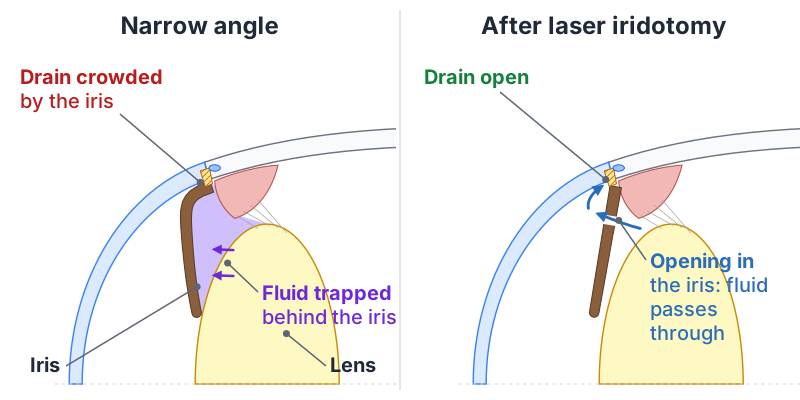
In an eye with a narrow drainage angle, the iris can block the eye's drain and raise the pressure, slowly or suddenly. A tiny opening near the edge of the iris lets fluid pass through, so the iris falls back and the drain is uncovered.
The visit
- Drops are placed: one makes the pupil small (it can cause a brow ache for a few hours), one prevents a pressure rise, and a numbing drop.
- A contact lens rests on the eye. The laser takes a few pulses; each is a bright flash with a click, and you may feel a quick pinch.
- The pressure is checked 30 to 60 minutes later.
- Bring a driver: vision is blurred for several hours. Often both eyes are treated, on the same day or separately.
Afterward
- Blurred vision for the rest of the day, and a mild ache or redness for a day or two.
- An anti-inflammatory drop for several days. Keep using any glaucoma drops unless told otherwise.
- There are no activity restrictions.
- A follow-up visit checks that the opening is clear.
- A line or ghost of light, from light passing through the opening, happens to a few people and often fades.
Medicines: after a working iridotomy, medicines labeled with a warning for "narrow-angle glaucoma" are generally safe. Confirm with your eye doctor.
Call the same day if
- Severe eye pain, or eye pain with nausea
- A marked drop in vision
- A very red eye